The 2026–2027 season · The debut season of Artistic Director and Principal Conductor Hannah von Wiehler
HUMAN
Alive in the AI age
What exactly makes us human?
We spend our days with machines that speak, write, and compose, and the oldest question has become urgent again. This season looks for the answer in the one art form that cannot be automated without ceasing to exist. Four themed concerts climb the oldest ladder there is, one rung at a time, from the body, to the elements our world is made of, to the mind, and finally inward, to the soul. Around them stand the traditions that anchor our year, and, new this season, Tahoe's first opera.
This is not a season about artificial intelligence. It is a season about us, and about the ancient conversation on who we are, made newly urgent by the machines we are building.
The Signature Series

October · Signature Series I
BODY
Before the season asks its great question, come meet the people who will spend the year answering it. Part concert and part show-and-tell, BODY brings you closer than a symphony concert usually allows, as our musicians step forward to introduce their instruments and reveal how the sound is truly made: horsehair drawn across gut, breath split on a sharp edge, a single reed crowing before it sings. Section by section they demonstrate their craft, before winds and strings join for Louise Farrenc's radiant Nonet, a chamber masterpiece forgotten for a century and blazing back to life.
Bach: Brandenburg Concerto No. 3
Messiaen: Quartet for the End of Time, third movement
Ravel: String Quartet, second movement
Malcolm Arnold: Three Shanties
Louise Farrenc: Nonet
Click button below for dates & locations
February · Signature Series II
ELEMENTS
In a world of screens, music remains our oldest way of paying attention to the real one. ELEMENTS is an evening about the raw materials of existence, air, water, earth, and light, and how deeply music can make us feel them. Respighi's The Birds opens with a garden full of song. Then Mihaela Martin, one of the most sought-after violinists of our era, sends a lark spiralling into the sky in Vaughan Williams’s The Lark Ascending, and sets the air alight in Saint-Saëns’s dazzling Introduction and Rondo Capriccioso. After the interval, the whole company turns to the water: Vaughan Williams’s A Sea Symphony, for chorus and orchestra, on the poems of Walt Whitman, a vast and exultant hymn to the ocean and to the voyaging human soul.
Respighi Gli uccelli (The Birds)Vaughan Williams The Lark AscendingSaint-Saëns Introduction and Rondo CapricciosoVaughan Williams A Sea Symphony (Symphony No. 1), for chorus and orchestra
Dates and venues to be announced


April · Signature Series III
MIND
Having met the body and the elements, we turn to the strangest instrument we own: the mind. Haydn's "Il distratto" is a portrait of a mind that cannot hold its thread, the truest description ever composed of the attention we now carry in our pockets. Then the mind we built, in Delibes' tale of an automaton so convincing a whole village falls for her, and a living answer in a brand-new work by the winner of our first Composition Prize. The evening closes with Caroline Shaw's luminous cantata on the Voyager Golden Record: attention as humanity's deepest power.
Haydn: Symphony No. 60, "Il distratto"
Delibes: Coppélia: Automaton Suite
Winner of the TOCCATA Composition Prize: World premiere
Caroline Shaw: The Listeners
Dates and venues to be announced
May · Signature Series IV
SOUL
Everything the season has asked arrives here. SOUL, conceived, arranged, and conducted by Hannah von Wiehler, is not a recital but a philosophical thriller told in continuous music and projection: a meditation on the oldest question we have. What does it mean to have a soul? In order to know what artificial intelligence is, and what it could become, we must first understand ourselves. Eighty-five minutes without interval, it moves as a single cinematic arc and ends with a final, live, unscripted encounter with an artificial intelligence, unfolding above the stage. No orchestra on earth is doing this.
With music by Stravinsky, Rachmaninov, Corelli, Vivaldi, Mozart, Beethoven, Mahler, Shostakovich, Arvo Pärt, and Hannah von Wiehler.
Dates and venues to be announced

The Traditions

December · A cherished tradition
Messiah
Some music belongs to the season itself. Every December, TOCCATA's chorus and orchestra gather for Handel's Messiah, the work our community returns to year after year and the flagship of our singers' art. This year's performance is a true Christmas Messiah: the prophecy and the Nativity complete, the Hallelujah at its heart, and a closing epilogue of the beloved final numbers, in a program of about ninety minutes.
Gardnerville, Reno, Truckee, and Incline Village
Dates to be announced
July · The summer tradition
Rhapsody in Silver
After a season of great questions, July is pure celebration. Rhapsody in Silver turns the lakeshore into a 1920s dream, a glittering nod to Nevada, the Silver State: black and silver, champagne and Art Deco, with a dance floor under the stars. Gershwin's Rhapsody in Blue anchors the evening, played by the winner of our new Concerto Prize, alongside Morton Gould's Concerto for Tap Dancer and Orchestra and the songs everyone half-remembers, from "Puttin' on the Ritz" to "Minnie the Moocher." Costumes encouraged. Dancing expected.
Reno, Incline Village, South Lake Tahoe, and Carson Valley
Dates to be announced · Veterans and active military attend free

August · Tahoe's first opera
Opera on the Lake
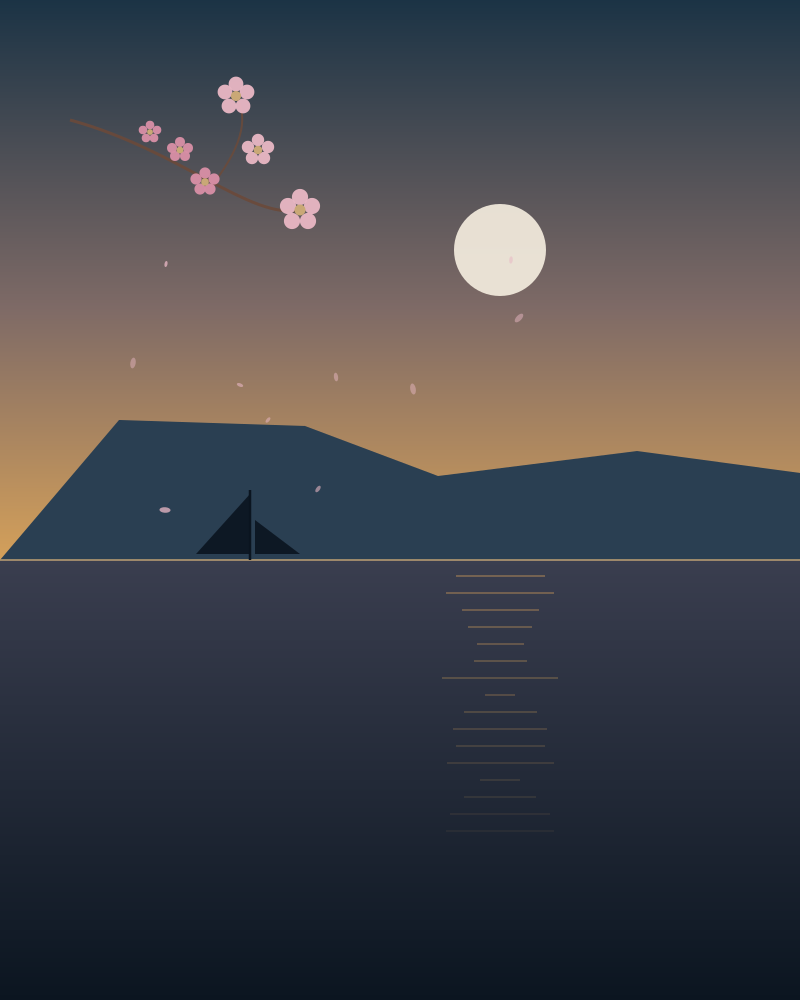
No one produces opera at Lake Tahoe, and we intend to change that with the most beloved title in the repertoire, staged where it belongs: at the water. Butterfly's drama is a harbor, an arriving ship, a young woman watching the horizon for a love that will not return; at dusk on the lake, the setting becomes the set, and the Humming Chorus, sung from the shoreline, arrives exactly as the light goes. For more than a century audiences have been undone by this story, and by some of the most ravishing music Puccini ever wrote. Three shores, three performances, and, we hope, the beginning of a new annual tradition.
Puccini: Madama Butterfly
Three lakeside venues · Dates to be announced